
Boarding
Boarding at The Bunny BnB offers safe accommodation for rabbits and guinea pigs while you are away. The space is full of species-specific enrichment and adequate space to cater to their mental and physical needs. We also offer boarding for bunnies and piggies with more complex medical needs. On a case-by-case basis we can make accommodations during the off-season for veterinary visits to Carevets Mount Wellington if required.
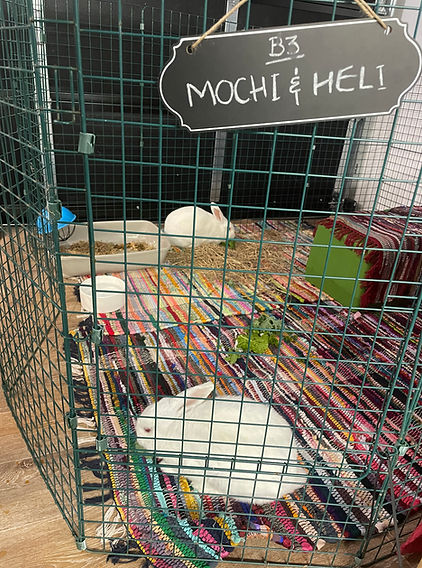
There are 9 bedroom suites. 3 doubles and 6 singles. Each enclosure has litter trays, hay containers, water bowls, hides and towels/ blankets/ Chindi rugs on top of foam mats to prevent hock sores.
Hay and greens are provided during their stay, but pellets will need to be provided by bunny and piggy parents.
There are three Binky Zones that allow our guests to stretch their legs, forage and explore. One Binky Zone is set-up for guests staying for a longer duration (4-weeks+) or can be split into two fully enclosed runs for bonding.
We offer nail trims and grooming as an add-on for our guests.
The space has air-conditioning for the comfort of our guests. We also have two CCTV cameras to provide around the clock monitoring and peace of mind for fur-parents.
At The Bunny BnB we have strict cleaning protocols and primarily use F10 (a rabbit-friendly cleaning agent).
We encourage parents to bringing bedding and toys to make their bunnies and piggies feel more at home.


Bonding
Rabbits are a social species that experience higher levels of stress when housed in solitude, compared to rabbits housed with other rabbits. It is recommended that rabbits have other rabbit companions to meet their welfare requirements.
The bonding process can take anywhere from a few days to a few months, but we are here to help you along the way. At The Bunny BnB we offer a unique two-week boarding stay dedicated to the three-stage bonding process.
Rabbits MUST be vaccinated with Filavac to board with us (rabbits can be vaccinated as young as 10-weeks old). The Cylap vaccine only protects rabbits against the older strain of Calicivirus so we cannot accommodate bunnies that have not had the Filavac vaccine.
We require that both bunnies be desexed 6-weeks prior to their booking for bonding to prevent unwanted pregnancies between intersex pairings and to prevent negative hormonal behaviours. Un-neutered and neutered pairings of any sex will show the un-neutered individual displaying unwanted mating behaviours towards their neutered counterpart (aggression, humping etc.). The length of gestation for rabbits is typically 31-days but can range anywhere from 30-33 days. Male rabbits can be fertile as young as 10-weeks old. Female rabbits can become pregnant at 3-months old. It is recommended that rabbits be desexed between 4-6-months old. Rabbits reach sexual maturity at 3-6-month old. The benefits of desexing include:
-
Prevention of breeding in intersex pairings (M:F)
-
Prevention of unwanted behaviours towards other rabbits in same sex pairings (M:M, F:F)
-
Prevent inappropriate urination
-
Prevention of uterine cancers in female rabbits (~80% of females will develop the disease after 4-years old.
-
Prevent negative behaviours such as:
-
Spraying
-
Humping and mounting
-
Aggression
-
Both rabbits need to be adults to establish a true and stable bond. We do not offer bonding of more than two rabbits due to the complexity and space requirements for that process.
Female-Male F:M bonds - We recommend intersex pairing (Male:Female), as these form the most stable bonds. Both rabbits need to be desexed to avoid negative hormonal behaviours towards the desexed individual and to prevent unwanted pregnancies if both rabbits are intact.
Male M:M bonds – entire males risk of damage to genital area due to mounting behaviours. Two intact males should not be housed together when they reach sexual maturity. Two neutered males can be kept together and the bond can be stable. Neutered M:M pairings are considered more stable than neutered F:F pairings.
Female F:F bonds – Female rabbits should always be desexed due to the high probability of developing mammary and uterine pathology; specifically uterine adenocarcinoma. Un-desexed females can also display resource guarding behaviours around food, water and ‘safe spaces’, restricting access for their subordinate female counterpart. These negative behaviours may not be evident until the females reach sexual maturity. Neutered F:F pairings can have stable bonds.

The set-up involves a contained Omlet run with a barrier in between. These runs are sturdy and have high sides with a roof (motivated rabbits can easily escape runs with a 2m panel height). The double barrier is originally placed far enough apart that fighting cannot occur between the bars. I use wood between the two sections so that the rabbits cannot push the barriers together. Further into the bonding process I replace the piece of wood with rodent mesh and one barrier (eventually removing the rodent mesh). Having the second stage of the bonding process take place at The Bunny BnB, allows for bunnies to get to know each other in a “neutral space”.
Tools and principles we use during the bonding process:
-
At The Bunny BnB we use an appeasing pheromone called “RabbitComfort” spray and “pet remedy” diffusers to reduce stress and create a calm environment.
-
We do not swap litter during the bonding process as this can cause problematic territorial behaviours and induce high levels of stress (the rabbits can smell each others scent by other means). Rabbits use latrines as an olfactory and visual way of marking their boundary. During the bonding process, toileting outside of the litter tray is more frequent.
-
We gradually introduce the scent of another rabbit on blankets and bedding in a neutral space. Bonding in a “neutral space” prevents rejection and fighting, especially if reintroducing two individuals that had previously been bonded.
-
We do not believe in the principles of “stress bonding”.

Image retrieved from: www.chooks.co.nz
Getting a second bunny
Things to consider when getting a second rabbit for a singleton bun:
-
Age
-
Temperament
-
Breed
-
Medical needs
Although extremely rare, there is such a thing as an “anti-social rabbit”. Whereby they do not benefit from rabbit-rabbit interactions like most other individuals of the species. We will be completely transparent if we feel that remaining solo is in your bunny’s best interest.
Rabbit behavioural problems that arise before bonding needs to be addressed before considering introducing a second bun. Behaviours such as aggression, chewing and excretion could stem from many causes such as:
-
Pain
-
Fear
-
Boredom
-
Frustration
-
Learned-attention seeking
-
Welfare issue – lack of ability to perform natural behaviours in their environment.
-
Social problems: e.g social and territorial issues, hierarchical incompatibility, lack of recognition due to separation, sexual status.

Feeding
(The following pertains to animals that are healthy adults, with an ideal body condition score and have no additional energy requirements)
HAY: Rabbits and guinea pigs should have access to unlimited hay. At The Bunny BnB, bunnies and guinea pigs will receive top quality Timothy or Meadow hay.
GREENS: Rabbits will receive one cup and guinea pigs will receive half a cup of greens each day.
PELLETS: Rabbits will receive one egg cup per 2.4kgs. Guinea pigs will receive one teaspoon.
WATER: Rabbits and guinea pigs will always have a fresh water supply. Water is given to rabbits and guinea pigs in bowls (NOT water bottles for hygiene reasons).

(Image: shows a list of rabbit friendly foods and the quantity and frequency at which they should be given, credit: Dr. Kezia Lockhart)


